
Korg Volca Beats
A capable drum machine (analog) for hands-on beat-making.
Drum machines range from pocket-sized analog boxes to full grooveboxes, and the right choice depends on your sound, workflow and setup. This guide walks through the key decisions so you pick one you'll actually make beats on.
The biggest choice is the sound engine. Analog drum machines create sound from electronic circuits, giving warm, punchy, tweakable character - the classic 808/909 sound behind decades of dance and hip-hop. Digital and sample-based machines store sounds as samples or generate them digitally, offering far more variety, cleaner or more modern tones, and usually the ability to load or record your own samples. Neither is better - analog is about character and immediacy, digital about flexibility and range. Many modern machines (like the Roland TR-8S) blend both.
How you program beats matters as much as the sounds. Nearly all drum machines use a step sequencer - you tap in hits across a grid of steps to build a pattern, then chain patterns into songs. Consider how many sounds or drum parts are on board, whether you can tune and shape each one, and whether the machine samples (letting you add your own sounds). Above all, think about workflow: some machines are immediate and hands-on with a knob or button per function; others are deeper but menu-driven. The best one is the one whose workflow makes you want to keep making beats.
If you'll use the machine alongside other gear, check its connectivity: MIDI and USB let it sync with a DAW, keyboard or other instruments, while sync and CV/gate connect it to modular and vintage equipment. If you want to make beats away from a desk, look for battery power, a compact size and ideally a built-in speaker - pocket operators and the Korg Volca excel here. A machine that fits your space and setup gets used far more than one that doesn't.
A drum machine is standalone gear for making beats and rhythm tracks by hand - it's immediate, tactile and inspiring in a way that clicking in a DAW often isn't. What it isn't: a full production suite (though grooveboxes get close), or an electronic drum kit you play with sticks. There's a learning curve to mastering the deeper features, but you can make a beat within minutes. Match the sound and workflow to how you make music, and a drum machine becomes the heart of your setup.
A capable drum machine (analog) for hands-on beat-making.

A capable drum machine (analog) for hands-on beat-making.

A capable drum machine for hands-on beat-making.

A capable drum machine for hands-on beat-making.

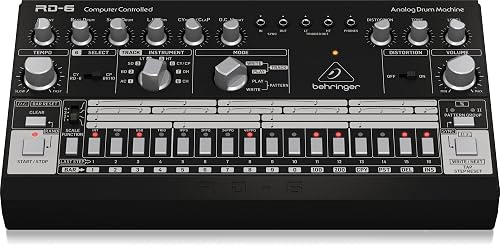
A capable drum machine (analog) for hands-on beat-making.
Start with the sound engine (analog for warm classic character, digital/sample for flexibility), then the sequencer and workflow, the sounds and whether it samples, and the connectivity to fit your setup. Portability matters if you'll make beats on the go. The best machine is the one whose workflow you enjoy.
There's a learning curve to the deeper features, but the basics are quick - step sequencers are intuitive, and you can make a beat within minutes on most machines. Simpler, more affordable models (Korg Volca, Pocket Operators, Alesis SR-16) are the friendliest to start on and grow from there.
Our top pick is the Korg Volca Beats (our score 9.6/10) - A capable drum machine (analog) for hands-on beat-making..