
Korg Volca Beats
A capable drum machine (analog) for hands-on beat-making.
Drum machines look daunting with all those buttons, but the basics are simple and quick to learn. Here's how to get from unboxing to your first beat.
Almost every drum machine works around a step sequencer - a row of buttons (usually 16) representing steps in a bar. You choose a drum sound (kick, snare, hat), then press the step buttons where you want that sound to hit; the machine loops the pattern so you hear it build up. Add the kick on the strong beats, the snare on the backbeats, and hats to fill in, and you've got a beat. Because it loops as you go, you hear changes instantly, which makes learning fast and fun.
Once you can program a pattern, you build up: layer more sounds, tweak each drum's tone and volume, and use functions like accents, swing and fills to add feel. Then chain several patterns together into a song - a verse pattern, a chorus, a breakdown. Save your patterns, and connect the machine to other gear via MIDI or USB if you want to sync it or record into a computer. From there it's practice and experimentation - the more you play, the more the workflow becomes second nature.
A capable drum machine (analog) for hands-on beat-making.

A capable drum machine (analog) for hands-on beat-making.

A capable drum machine for hands-on beat-making.

A capable drum machine for hands-on beat-making.

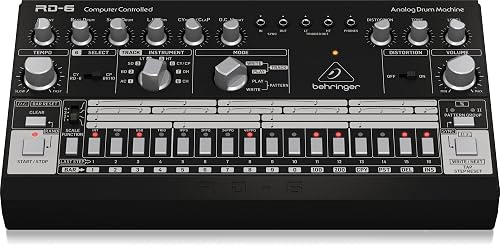
A capable drum machine (analog) for hands-on beat-making.
Pick a drum sound, then use the step sequencer - press the step buttons where you want that sound to hit across the bar. Add a kick on the main beats, a snare on the backbeats and hats to fill in, and the machine loops it so you hear the beat build. Layer more sounds and tweak from there.
Yes - the step sequencer is intuitive and you can make a beat within minutes, so they're a great, hands-on way to start making music. There's depth to grow into, but simpler models (Korg Volca, Pocket Operators, Alesis SR-16) are very approachable for beginners.
Our top pick is the Korg Volca Beats (our score 9.6/10) - A capable drum machine (analog) for hands-on beat-making..