Behringer RHYTHM DESIGNER RD-6-BK vs Behringer RHYTHM DESIGNER RD-6-SR
We compare the Behringer RHYTHM DESIGNER RD-6-BK and the Behringer RHYTHM DESIGNER RD-6-SR across every dimension that matters - our scores, the key specs, and how each performs on the things you will actually notice day to day.
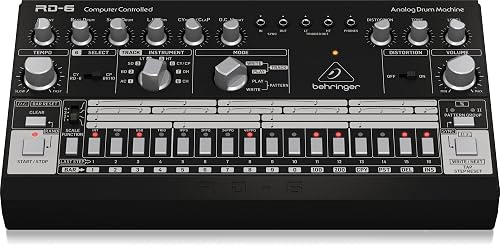

At a glance
| Behringer RHYTHM DESIGNER RD-6-BK | Behringer RHYTHM DESIGNER RD-6-SR | |
|---|---|---|
| Our score | 9.1/10 | 9.5/10 |
| Best for | Making beats and rhythm tracks hands-on, standalone, without a computer | Making beats and rhythm tracks hands-on, standalone, without a computer |
| Not ideal for | Anyone wanting a full DAW, or an electronic drum kit you play with sticks | Anyone wanting a full DAW, or an electronic drum kit you play with sticks |
| Brand | Behringer | Behringer |
Sound and Character
Behringer RHYTHM DESIGNER RD-6-BK
Sound-wise, this drum machine is an analog drum machine with eight drum sounds. Its character comes from how those analog drum voices respond as patterns are played, keeping each sound distinct even when rhythms become denser. Included distortion effects can push the drums towards a harsher edge, which suits heavier, busy styles, but it can also reduce the sense of clean transients. Where dynamics are important, careful level matching helps maintain contrast between hits, since stronger distortion can blur differences in impact.
Behringer RHYTHM DESIGNER RD-6-SR
Sound from the drum machine is built around 8 drum sounds, with a character designed for analog-style drum programming rather than acoustic realism. Each sound is intended to sit in tight patterns, and the transients are described as punchy and consistent from hit to hit. Distortion effects are included, so heavier settings can introduce extra grit that may blur finer dynamics. As a result, the RD-6-SR suits genre-ready drum loops, while sampled, naturalistic drum kits may sound less natural.
Sequencer and Workflow
Behringer RHYTHM DESIGNER RD-6-BK
With a 64-step sequencer built in, the Behringer lets users program drum patterns by deciding where each of its eight drum sounds hits across the steps. The pattern grid maps directly to timing positions, keeping sequence planning clear. In workflow, a user selects a sound, turns steps on or off, and listens for placement before changing the pattern.
Behringer RHYTHM DESIGNER RD-6-SR
Sequencer depth shapes how the RD-6-SR turns its eight drum sounds into working drum parts, shifting attention from individual sound character to pattern construction and editing. With a 64-step sequencer, the user can place rhythms across a fixed grid, then refine timing by changing step contents. Pattern work remains hands-on because edits directly affect playback, rather than requiring deep menu navigation. The key advantage is straightforward iteration, while the fixed-length layout can feel limiting for longer song structures. Workflow focuses on composing patterns first, then arranging them, with no specified detailed variation tools.
Connectivity and Sync
Behringer RHYTHM DESIGNER RD-6-BK
Because the title only confirms an analog drum machine with 8 drum sounds, a 64-step sequencer, and distortion effects, any MIDI, sync, or line-level integration details cannot be verified from the information provided. This means setup may rely on standalone operation where the sequencer runs its own timing. If external gear sync is important, the official manual or retailer listings should be checked for confirmed connectivity details.
Behringer RHYTHM DESIGNER RD-6-SR
Connectivity and sync determine how easily the RD-6-SR fits into a larger music setup, especially when it needs to lock with other gear. The product title describes an analog drum machine with 8 drum sounds, a 64-step sequencer, and distortion effects. Buyers should check the full manual for clock, timing, or MIDI support, because otherwise tempo matching may rely on manual playback. If sync inputs are available, the 64-step pattern can align tightly with synced tracks, improving sequencing consistency across devices.
Portability and Build
Behringer RHYTHM DESIGNER RD-6-BK
Since the RD-6-BK is an analogue drum machine, it likely uses a standard enclosure for the 8 drum sounds and the 64-step sequencer, but the materials, casing thickness, and any specific protective design are not stated. For moving it between rooms or rehearsals, buyers must check real-world photos and listings for the footprint, knob clearance, and any practical additions. If the unit lacks isolation, vibration may affect fast setup, so careful placement helps.
Behringer RHYTHM DESIGNER RD-6-SR
Portability and build matter for the RD-6-SR because it is intended for use in both a studio and for short sessions, yet the product title does not provide any weight, dimensions, or hardware details beyond being an analog drum machine with distortion effects. Without published measurements, desk-space needs, rack compatibility, and how stable it feels for mobile use cannot be assessed directly. The form factor can only be inferred from its tabletop-style presentation, but this is not explicitly confirmed. No ruggedisation is stated, though the analog control approach suggests a typical hardware layout for this category.
Who Is This Drum Machine For?
Behringer RHYTHM DESIGNER RD-6-BK
This drum machine will most likely suit people who want a hands-on analogue rhythm box built around pattern programming, rather than a full studio workstation. The drum machine supports programming with a 64-step sequencer, making it practical for hearing edits as you change the pattern. It is also designed for beginners who want 8 drum sounds, with the limited sound set keeping choices simple. More advanced users may still find it useful for rhythm-focused work, particularly if distortion effects are of interest, rather than for deep synthesis and broader production workflows.
Behringer RHYTHM DESIGNER RD-6-SR
Who is the Behringer for, and who might it additionally not suit? It fits players who want an analog drum machine with 8 drum sounds and a 64-step sequencer, particularly if they prefer straightforward pattern creation and hands-on rhythm building. Because distortion effects are available, it also suits those who want extra grit on drum parts. The fixed number of sounds and sequencer steps can feel limiting for producers who need larger sound variety or very long, multi-section arrangements. It suits beginners seeking a manageable workflow, but it may not suit advanced users who want broader sound design options.
Behringer RHYTHM DESIGNER RD-6-BK: pros
- Analog sound engine
- 8 sounds onboard
- 64-step sequencer
- Standalone hands-on beat-making, no computer needed
Cons
- A learning curve to master the deeper features
- Takes up desk space in a setup
- It's a drum machine, not a full DAW or an acoustic-style drum kit
Behringer RHYTHM DESIGNER RD-6-SR: pros
- Analog sound engine
- 8 sounds onboard
- 64-step sequencer
- Standalone hands-on beat-making, no computer needed
Cons
- A learning curve to master the deeper features
- Takes up desk space in a setup
- It's a drum machine, not a full DAW or an acoustic-style drum kit
Our verdict
Our pick is the Behringer RHYTHM DESIGNER RD-6-SR (our score 9.5/10) - A capable drum machine (analog) for hands-on beat-making. The Behringer RHYTHM DESIGNER RD-6-BK is still worth it if it is cheaper when you check, or if it better matches your specific needs.